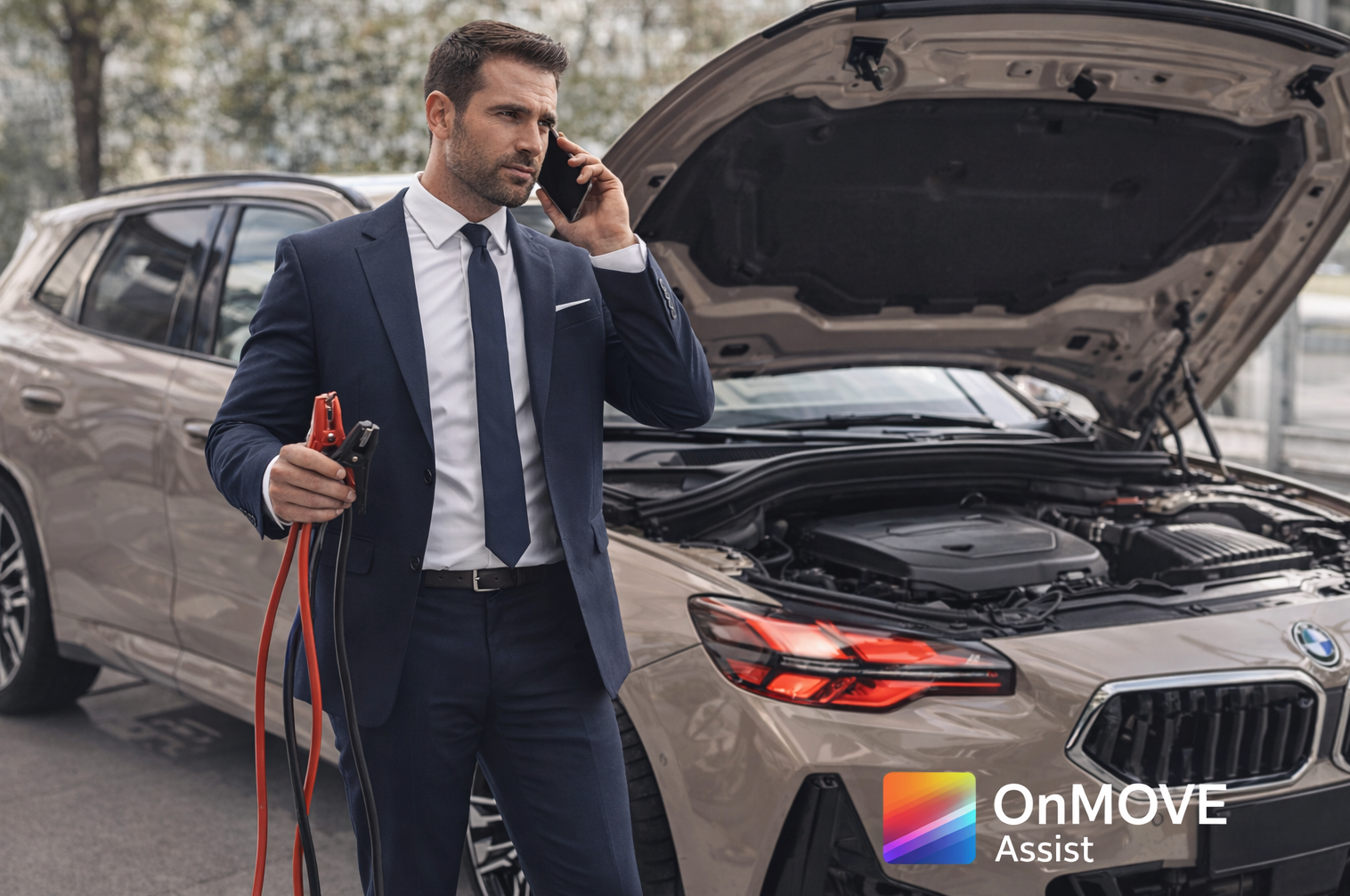
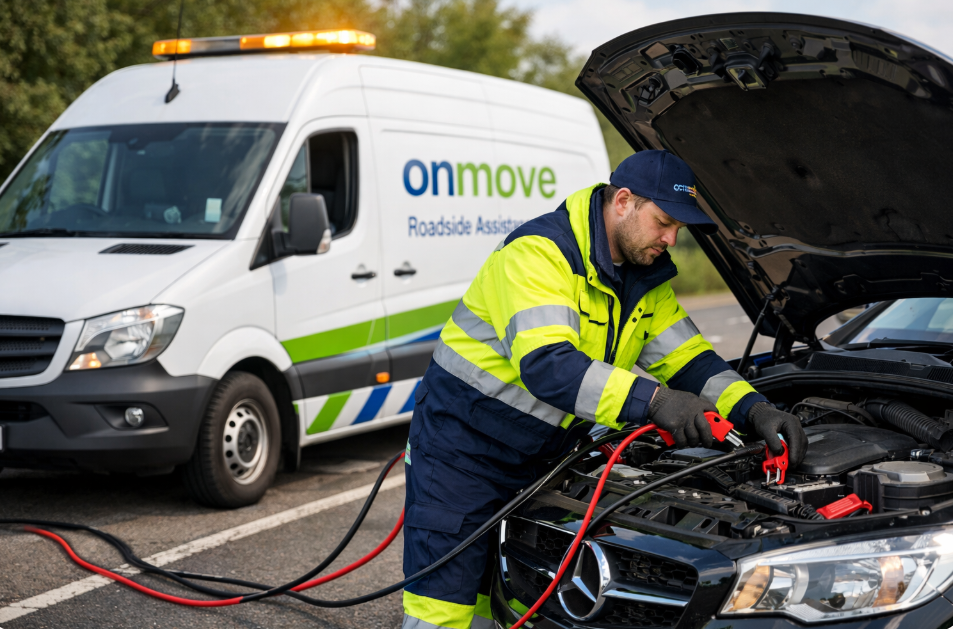
Jump Start Services
24/7 roadside battery support
Realisation moment


OnMOVE

Jump Start Services

Realisation → Response → Rescue → Relief


Professional jump start services

Safe, expert Jump Starts for modern vehicles.

OnMOVE delivers technician‑grade jump start assistance using the correct connection sequence, safe grounding points, and manufacturer‑aligned procedures—so you’re moving again without risking your vehicle’s electronics.

Red to Dead · Red to Good · Black to Good · Black to Ground
ECU‑safe methods for modern cars
onmove

London, UK

📋 View safety protocol
Coverage: Roadside · Home · Workplace Focus: Safety, correct sequence, battery health


Realisation moment

Step‑by‑step jump start protocol

OnMOVE follows a structured, safety‑first process that mirrors leading automotive guidance from Onmove, Bosch, and professional technicians.

  1. Preparation & positioning
    Vehicles are parked close enough for cables to reach, but never touching. Ignitions are switched off and keys removed where applicable.
  2. Battery & cable inspection
    We visually check for cracks, leaks, swelling, or frozen batteries—these are never jump‑started. Only heavy‑gauge, high‑quality cables or professional boosters are used.
  3. Correct connection order
    Red to Dead → Red to Good → Black to Good → Black to Ground. This sequence minimises sparks near the battery and protects sensitive electronics.
  4. Start‑up & stabilisation
    The donor vehicle is started first and allowed to run for 1–3 minutes before attempting to start the disabled vehicle. If it doesn’t start, we reassess for deeper faults such as alternator issues.
  5. Safe cable removal
    Cables are removed in reverse order: Black from ground → Black from donor → Red from donor → Red from dead. The revived vehicle is then left running to recharge the battery.
Ground‑first safety: OnMOVE always prefers a solid metal earth point over the negative terminal on the disabled battery, reducing explosion and spark risk.
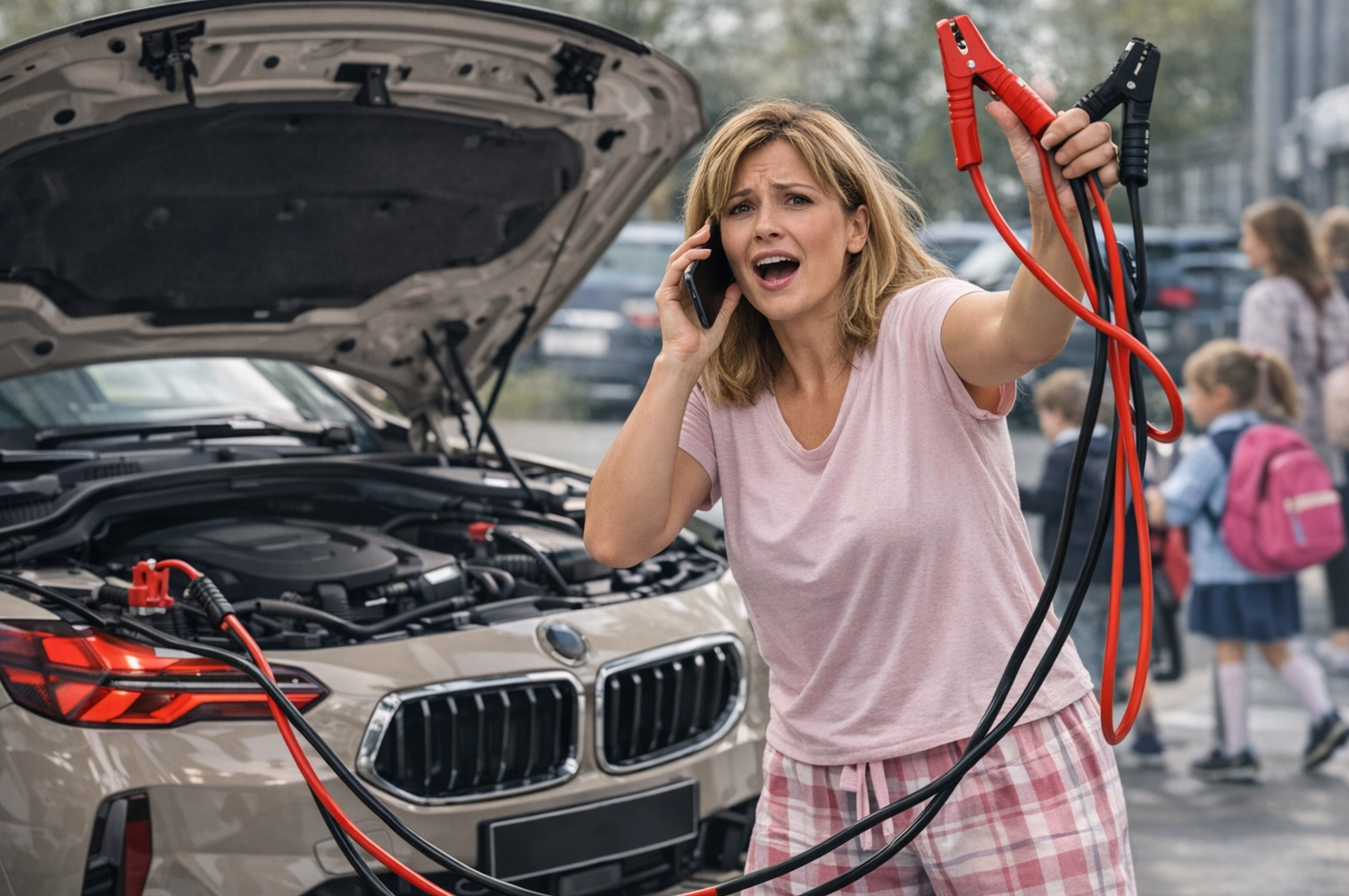
The science & common mistakes

A healthy car battery typically sits around 12–12.6 volts. When it drops too low, the starter motor can’t turn the engine. A controlled jump start temporarily supplies the missing current while protecting the vehicle’s electronics.

  • Battery vs alternator: If the car starts but then quickly dies, the alternator may not be charging. OnMOVE technicians can help you understand the likely cause.
  • Modern ECUs: Today’s vehicles are packed with sensitive control units. Our methods are designed to avoid voltage spikes and incorrect polarity that can damage electronics.
Critical mistakes we avoid:
  • Reversed polarity: Mixing up positive and negative can severely damage ECUs, alternators, and wiring. OnMOVE uses clear labelling and a fixed sequence to prevent this.
  • Clamps touching: Once connected, clamps are kept separated and controlled to avoid arcing and sparks.
  • Damaged or frozen batteries: Cracked, leaking, or frozen batteries are never jump‑started due to explosion and acid risks.
  • Cheap, undersized cables: Low‑quality leads can overheat and fail to transfer enough power. OnMOVE uses professional‑grade equipment only.


Realisation moment