Vehicle Checks
View Checks
Pre‑use and post‑use inspections to ensure recovery vehicles are roadworthy and compliant.
Check Equipment, Tyres Fuel, Lights, Oil, Water, Electrics.

Technical & Operational Procedures . (Safe working of vehicle breakdown, recovery and removal operations) Compliance relies heavily on proof of competence.
Pre‑use and post‑use inspections to ensure recovery vehicles are roadworthy and compliant.
Check Equipment, Tyres Fuel, Lights, Oil, Water, Electrics.
Availability and maintenance of cones,amber warning beacons, warning triangles, 360 ∘ visibility, Lifting Equipment: tested every 6 or 12 months. Straps rated for the weight of the vehicle being recovered.
Verified competence, particularly at the scene of a breakdown, induction, and ongoing training aligned with PAS 43 and company procedures.
Correct use of high‑visibility garments, helmets, gloves, and footwear at all times on scene.
ID by National Training and Assessment Scheme.
Clear, documented actions for Collisions, injuries, near‑misses, and escalation to emergency services.
Casualty vehicle : The Road name or number, mobile phone,Marker Post Number, junction numbers, service area , travel direction, registration number, passengers, Disabled and Vulnerable. small children.
Dynamic on‑scene risk assessment covering traffic flow, weather conditions, and ground stability, vehicle position, and third‑party risks.
Prior assembly of any recovery/removal equipment to minimise the time spent at scene.
Statutory removal: Traffic Officers must be present at the scene in order to invoke their Statutory Powers to remove a vehicle
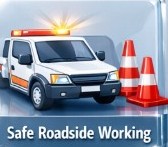
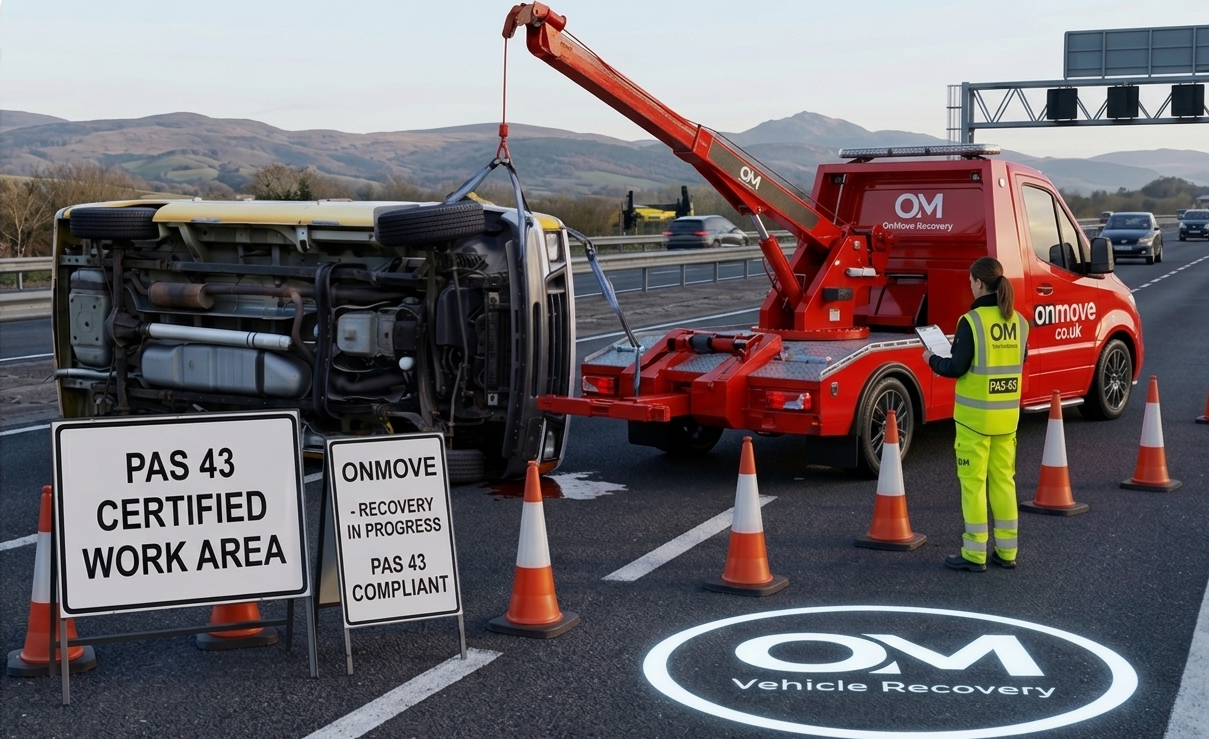
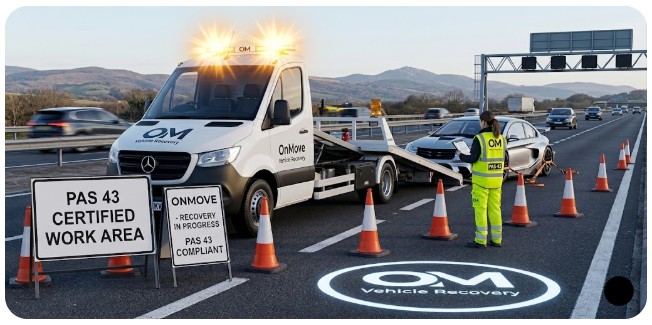
Positioning of vehicles, cones, and personnel to minimise exposure to live traffic and hazards.
Objective : improve the safety of all concerned whilst Technicians are working on all types of road.
SOS Areas provide space for emergency use by motorists and for incident management and maintenance purposes and contain:
Emergency Roadside Telephones (ERT) or SOS phones,dedicated CCTV coverage and a driver location sign

Timely, accurate reporting and recording of incidents, defective or missing items, and non‑conformances for audit.
Regional Control Center (RCC), Highways England (0300 1235000)
answer emergency roadside telephones, setting signals and variable message signs, on-road Traffic Officer Patrols that liaise with incident responder organisations.
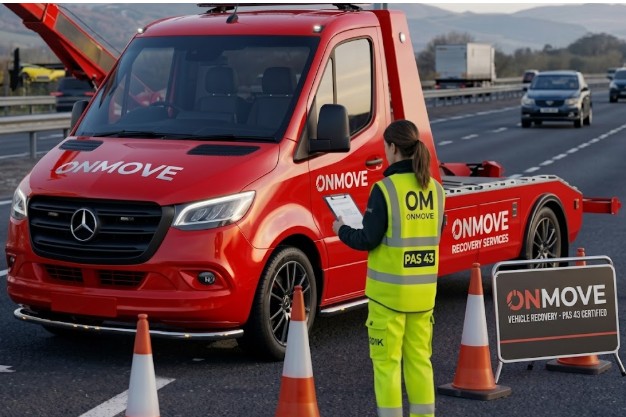
PAS 43 requires a structured management environment, often mirroring aspects of ISO 9001. Insurance: Public Liability, Employers’ Liability, and "Road Risks" insurance, (On-Hook insurance). Environmental Policy: roadside spills (oil, coolant, etc. Annual Audits: To maintain PAS 43 status, an operator must undergo an annual inspection by a UKAS-accredited certification body to prove they are still following all the rules..
Tichafa - Aligned with PAS 43 technical and operational requirements for recovery operators.
Standards Institute. standard document,
BSI Knowledge - PAS 43:2024
SURVIVE Group (The Sponsoring Body): (the database of PAS 43 accredited operators)
SURVIVE PAS 43 Database
Customer Services. Tel 020 8996 9001 Call 9-1-1.
. PAS 43‑Aligned Technician Training (IVR Core Modules)
If you’re asking about training for roadside technicians, the IVR (Institute of Vehicle Recovery) Core Modules VR01–VR03 are the recognised route.

Exceed Safety delivers PAS 43‑aligned IVR training

Their Core Modules (VR01, VR02, VR03) are a 2‑day course (classroom + practical)

These modules meet PAS 43 and NHSS17/17B requirements

Most UK providers charge:

£350–£550 per person for the 2‑day IVR Core Modules

Sometimes includes Driver CPC hours if requested

Summary
Type	What It Covers	Typical Cost
PAS 43 Certification (business)	Full audit + compliance for recovery operators	£1,000–£3,000 depending on size & days
PAS 43‑aligned IVR Technician Training	VR01–VR03 (H&S, Customer Service, Roadside Assessment)	£350–£550 per technician


 ==================================
 Training Route for a One‑Man Mobile Recovery Operator (UK)
1. Core Safety & Roadside Training (Mandatory for PAS 43‑aligned work)
You need the IVR Core Modules VR01–VR03. These are the foundation for anyone working roadside.

Modules include:
VR01 – Health & Safety

VR02 – Customer Service & Risk Assessment

VR03 – Roadside Recovery & Safety Procedures

Duration: 2 days
Typical cost: £350–£550
Why you need it:
These modules are recognised by PAS 43, NHSS17/17B, and all major recovery clubs (AA, RAC, Green Flag).

2. Specialist Recovery Training (Choose based on your service type)
If you operate a van with tools, not a full recovery truck, you only need the modules relevant to your service.

If you do wheel changes, jump starts, lockouts, diagnostics, mobile tyre fitting:
VR05 – Light Recovery / Roadside Assistance

VR06 – Customer Management & Scene Safety (optional but useful)

Cost: £150–£300 per module
Why:
Covers safe working on live roads, scene management, and dealing with customers under stress.

3. PAS 43 Compliance (For your business, not you personally)
PAS 43 is a company certification, not a training course.

For a one‑man operator:
You need a simple Quality Management System (QMS)

A Health & Safety policy

Risk assessments

Training records

Vehicle maintenance logs

PPE & equipment checks

Incident reporting process

Certification cost: £1,000–£3,000 depending on provider
Frequency: Annual surveillance audits

Tip:
Start trading first — you only need PAS 43 if you want contracts with insurers or clubs.

4. Optional but Highly Recommended Courses
These boost your credibility and reduce risk:

First Aid at Work (1 day)
Cost: £80–£150
Why: Required by most insurers and recovery clubs.

Manual Handling
Cost: £30–£60
Why: Protects you legally and physically.

Fire Safety Awareness
Cost: £20–£50
Why: Required for PAS 43 documentation.

Wheel Alignment / Tyre Technician Certification
Cost: £200–£500
Why: Strengthens your mobile tyre fitting credentials.

5. Insurance Requirements (Often overlooked)
To operate legally and safely, you need:

Road Risk Insurance (for driving customer vehicles)

Public Liability Insurance (£1m–£5m)

Employers Liability (not needed if you’re truly solo)

Tools & Equipment Cover

Breakdown / Recovery Insurance (for your own van)

Typical cost for a one‑man operator: £1,200–£2,500 per year

6. Equipment Competency (Self‑certified or trained)
If you use:

Winches

Dollies

Skates

Underlifts
 Wheel lifts